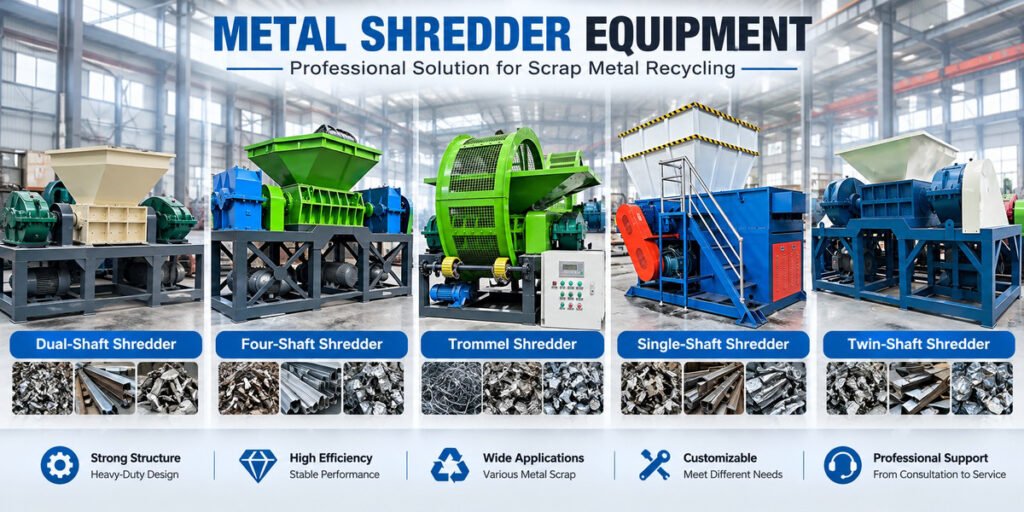
A metal shredder is an industrial machine used to reduce scrap metal into smaller pieces for recycling, separation, transportation, or further processing. Metal shredders can process suitable materials such as steel scrap, iron scrap, aluminum scrap, metal drums, automobile scrap, and industrial metal waste.
The best scrap metal shredder depends on your material size, metal thickness, required capacity, desired output size, and downstream recycling process. A machine suitable for light metal scrap may not be suitable for automobile bodies or heavy steel scrap.
In this guide, we compare eight common metal shredder types and explain how to choose the right metal shredder machine for your recycling business.
Table of Contents
What Is a Metal Shredder?
A metal shredder is a heavy-duty recycling machine designed to cut, tear, or shear metal scrap into smaller pieces.
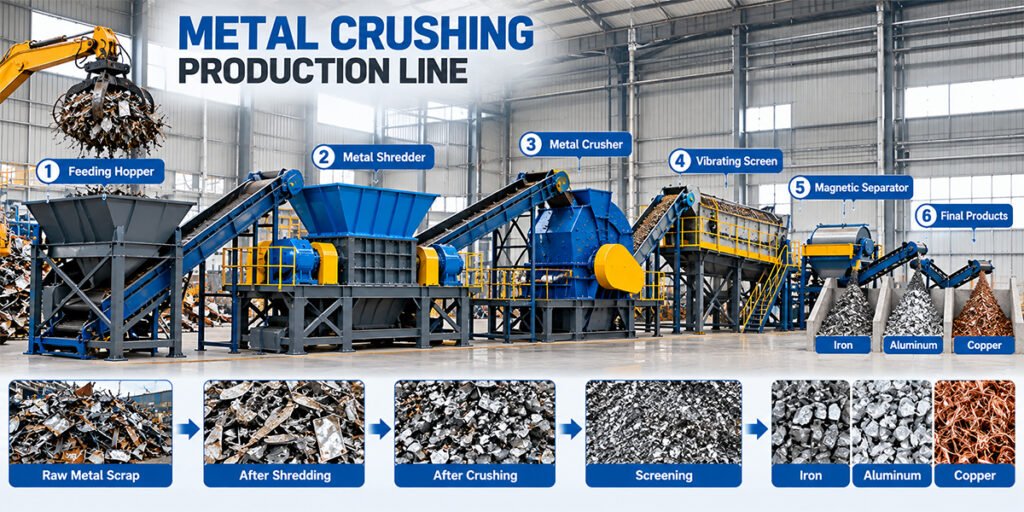
Metal shredding is often the first stage of a larger recycling process. After shredding, the material can move to magnetic separation, sorting, crushing, screening, or other downstream processing equipment.
Common materials processed by metal shredders include:
Scrap iron
Scrap steel
Aluminum scrap
Metal drums
Metal sheets
Industrial metal waste
Automobile scrap
Suitable mixed metal scrap
The correct metal shredder depends on the actual material rather than the machine name alone. For example, a recycling company processing large metal drums may require a different machine configuration from a company processing thick steel scrap.
Quick Comparison of Metal Shredders
The following table provides a quick comparison of common metal shredders and their applications.
Metal Shredder Type
Best For
Main Purpose
Processing Stage
Dual Shaft Metal Shredder
Bulky metal scrap
Primary size reduction
Primary
Heavy Duty Scrap Shredder
Heavy metal waste
Heavy-duty shredding
Primary
Steel Shredder
Steel scrap
Size and volume reduction
Primary
Scrap Iron Shredder
Iron scrap
Recycling preparation
Primary
Automobile Shredder
Vehicle scrap
Vehicle recycling
Complete system
Metal Drum Shredder
Drums and containers
Volume reduction
Primary
Four Shaft Shredder
Controlled size reduction
Additional shredding
Primary/Secondary
Metal Recycling Line
Mixed industrial scrap
Complete processing
Complete system
There is no single metal shredder machine that is suitable for every material. Your material characteristics and final processing requirements should determine the equipment configuration.
1. Dual Shaft Metal Shredder
A dual shaft metal shredder uses two rotating shafts fitted with cutters. The shafts pull material into the cutting chamber and tear it into smaller pieces.
This design is commonly used when the main purpose is primary size reduction. Depending on the cutter configuration and machine design, a dual shaft shredder can be used for suitable scrap metal, metal drums, aluminum products, industrial metal waste, bulky waste, and mixed recyclable materials.
One advantage of a dual shaft design is its ability to grab bulky material and pull it into the cutting chamber. However, the finished output is generally less uniform than equipment designed specifically for controlled particle sizing.
Best for: Bulky scrap and primary shredding.
2. Heavy Duty Scrap Metal Shredder
A heavy metal scrap shredder is designed for demanding recycling applications where the material is larger, thicker, or more difficult to process.
The term “heavy duty” does not refer to one specific machine structure. The machine should be selected according to the actual raw material and processing requirements.
Important factors include:
Metal type
Material dimensions
Material thickness
Required throughput
Feeding method
Required output
Downstream equipment
If your material contains large or thick metal pieces, provide the manufacturer with photos, videos, dimensions, and thickness information before selecting a machine.
Do not choose a heavy-duty metal shredder only according to motor power. The cutting system, shaft structure, cutter design, drive system, feeding method, and overall machine construction are also important.
Best for: Heavy and demanding scrap metal applications.
3. Steel Shredder
A steel shredder is used to reduce suitable steel scrap before recycling, separation, transportation, or further processing.
However, “steel scrap” covers many different materials, including:
Steel sheets
Production offcuts
Steel drums
Steel components
Light structural scrap
Industrial steel waste
Before selecting a steel shredder, confirm the maximum dimensions and thickness of the material. If the material is especially large or heavy, it may require pre-processing or a customized feeding system.
Best for: Steel scrap from manufacturing and recycling operations.
Tire crushing
scrap iron
Metal crushing
Plastic crushing
4. Scrap Iron Shredder
A scrap iron shredder reduces suitable iron scrap into smaller pieces for easier handling and downstream recycling.
Scrap iron may come from manufacturing plants, machining facilities, recycling yards, demolition operations, or other industrial sources.
The correct machine depends on the physical form of the iron scrap. Loose light iron scrap and large heavy iron parts have very different shredding requirements.
Before choosing equipment, determine:
Maximum feeding size
Maximum material thickness
Required processing capacity
Desired output size
Downstream recycling process
This information helps determine whether you need a standalone scrap iron shredder or a complete metal recycling line.
Best for: Iron scrap recycling and size reduction.
5. Automobile Shredder
Automobile recycling is a more complex application because vehicles contain steel, aluminum, plastics, rubber, glass, wiring, and many other materials.
An automobile shredder is therefore often part of a larger recycling process rather than a simple standalone machine.
A typical processing system may include:
Pre-processing → Shredding → Conveying → Magnetic Separation → Sorting → Further Processing
The exact process depends on the condition of the vehicle scrap and the required recycled products.
If you process automobile scrap, tell the equipment manufacturer whether you are handling complete vehicle bodies, pre-processed shells, automobile parts, or other vehicle scrap. This information is important when selecting and designing the shredding system.
Best for: Automobile and vehicle recycling operations.
6. Metal Drum Shredder
Metal drums and containers can occupy a large amount of storage and transportation space before processing.
A suitable industrial shredder can reduce their size before transportation, separation, or additional recycling.
Dual shaft shredders are often considered for bulky container applications because the two shafts can grab and tear the material. However, the correct configuration still depends on the drum material, dimensions, wall thickness, and condition of the material.
Best for: Metal drums, containers, and bulky light metal scrap.
7. Four Shaft Metal Shredder
A four shaft shredder uses four rotating shafts to provide additional cutting inside the shredding chamber.
Compared with equipment intended mainly for coarse primary shredding, a four shaft configuration can be considered when the recycling process requires additional size reduction or greater output control.
However, more shafts do not automatically mean a better machine.
If primary size reduction is your main goal, a dual shaft shredder may provide a simpler solution. A four shaft shredder becomes more relevant when the application requires further cutting and better control of the final material size.
Best for: Applications requiring additional size reduction and output control.
8. Complete Metal Recycling Shredder Line
For many industrial recycling projects, one metal shredder is only the first step.
A complete metal recycling system can combine shredding with conveying, separation, sorting, screening, or secondary processing.
The exact production line should be designed according to your raw material and desired final product.
For example, a customer who only wants to reduce scrap volume has different requirements from a customer who needs separated materials for resale or further processing.
Best for: Industrial recycling plants requiring continuous processing.
Which Metal Shredder Is Right for Your Material?
Choosing a scrap metal shredder starts with understanding the raw material.
The table below can help you make an initial selection.
Your Material
Shredder to Consider
Main Goal
Scrap Steel
Heavy-duty or dual shaft shredder
Size reduction
Scrap Iron
Industrial metal shredder
Recycling preparation
Metal Drums
Dual shaft shredder
Volume reduction
Automobile Scrap
Automobile shredding system
Complete recycling
Aluminum Scrap
Depends on material form
Size reduction
Bulky Metal Waste
Dual shaft shredder
Primary shredding
Mixed Metal Scrap
Customized recycling line
Shredding and separation
This table provides an initial reference only. The final machine configuration should always be based on the actual material, required capacity, and final output.
Dual Shaft vs Four Shaft Metal Shredder
Customers often ask whether a dual shaft or four shaft metal shredder is better.
The answer depends mainly on the material and required output.
A dual shaft metal shredder is generally focused on primary shredding and volume reduction. It is useful when large or bulky materials need to be torn into smaller pieces.
A four shaft shredder provides additional cutting and can be considered when greater control over the final material size is required.
Feature
Dual Shaft
Four Shaft
Number of Shafts
2
4
Main Purpose
Primary shredding
Additional size reduction
Bulky Material
Strong application
Application dependent
Output Control
Lower
Higher
Machine Complexity
Lower
Higher
Typical Position
Primary processing
Primary/secondary processing
Do not select a four shaft machine simply because it has more shafts. The machine should match your raw material and final processing requirements.
Metal Shredder vs Metal Crusher
A metal shredder and a metal crusher are not always the same machine.
A metal shredder mainly uses cutting, tearing, or shearing action to reduce large scrap into smaller pieces.
A metal crusher generally performs further size reduction and may use impact, hammering, or crushing forces depending on the machine design.
In some recycling systems, both machines can be used:
Metal Shredder → Conveyor → Metal Crusher → Separation
Whether you need one machine or both depends on the raw material and required final product.
How to Choose a Metal Shredder
Before purchasing a metal shredder machine, we recommend confirming the following information.
1. What Material Do You Need to Shred?
Do not simply tell the manufacturer that you need to process “metal.”
Specify whether the material is steel, iron, aluminum, metal drums, automobile scrap, production waste, or mixed metal scrap.
Different materials require different machine configurations.
2. What Is the Maximum Feeding Size?
Measure the largest pieces of material and provide:
Length × Width × Height
Photos and videos of the actual material are also useful when selecting a machine.
3. How Thick Is the Metal?
Material thickness can significantly affect machine selection.
This is especially important when processing steel, iron, and other heavy metal scrap.
4. What Capacity Do You Need?
Tell the manufacturer how much material you need to process per hour.
The equipment required for a small recycling operation can be very different from a continuous industrial production line.
5. What Output Size Do You Need?
Some customers only need volume reduction. Other customers require smaller material for separation, secondary crushing, or further recycling.
Your desired output can affect the shredder structure and processing line configuration.
6. What Happens After Shredding?
Consider what you plan to do with the material after shredding.
Will it be:
Sold directly?
Magnetically separated?
Crushed again?
Screened?
Melted?
Sent to another recycling process?
Your downstream process should be considered before selecting the shredder.
7. What Is Your Local Power Supply?
For export projects, provide your local:
Voltage / Frequency / Phase
This allows the electrical system to be configured according to the project requirements.
8. How Will You Feed the Machine?
Depending on the material and project, feeding can use conveyors, grab equipment, or other suitable feeding systems.
For continuous processing, the feeding system should be considered as part of the complete recycling line.
Do You Need One Shredder or a Complete Recycling Line?
A standalone metal shredder can be suitable when your main goal is basic size reduction.
A complete processing line may be more suitable when you need continuous feeding, separation, sorting, secondary crushing, screening, or automatic material handling.
A typical process can be:
Scrap Metal → Feeding System → Metal Shredder → Conveyor → Magnetic Separation → Secondary Processing → Finished Recyclable Material
Before investing in a complete recycling line, define the final product you want to produce.
This allows the equipment configuration to be designed according to your actual processing goal.
How Much Does a Metal Shredder Cost?
The price of a metal shredder machine depends on the material, machine size, cutting system, required capacity, drive configuration, feeding system, automation level, and supporting equipment.
For this reason, comparing prices without comparing machine configurations can be misleading.
For a more accurate quotation, prepare the following information:
Material name
Material photos or videos
Maximum feeding size
Maximum material thickness
Required capacity
Required output size
Country
Local power supply
With this information, the manufacturer can recommend a suitable machine configuration and prepare a quotation based on the actual project.
Frequently Asked Questions
What Is a Metal Shredder?
A metal shredder is an industrial recycling machine used to cut, tear, or shear metal scrap into smaller pieces. It can work as a standalone size-reduction machine or as part of a complete metal recycling system.
What Metals Can a Metal Shredder Process?
Depending on the machine configuration, suitable materials can include iron, steel, aluminum, metal drums, production scrap, automobile scrap, and other metal waste. Material dimensions and thickness should be confirmed before selecting a machine.
What Is the Best Shredder for Scrap Metal?
There is no single best scrap metal shredder for every application. The correct machine depends on the material type, size, thickness, required capacity, desired output size, and downstream recycling process.
Can a Metal Shredder Process Steel?
Suitable industrial shredders can process steel scrap. However, the correct machine depends on the size and thickness of the steel. Heavy steel applications require equipment configured for the actual material.
What Is the Difference Between a Metal Shredder and a Metal Crusher?
A metal shredder primarily cuts, tears, or shears large scrap into smaller pieces. A metal crusher generally performs additional size reduction using a different crushing mechanism. Some recycling lines use both machines.
Is a Dual Shaft Shredder Suitable for Metal?
A dual shaft shredder can be suitable for many bulky metal recycling applications. The cutter, shaft, drive system, and overall configuration should be selected according to the actual material.
How Do I Choose a Metal Shredder Machine?
Start with the material, maximum feeding size, metal thickness, required capacity, desired output size, and downstream process. Photos and videos of the actual scrap can help determine a suitable configuration.
How Much Does an Industrial Metal Shredder Cost?
The price depends on the material, capacity, machine configuration, cutting system, feeding method, automation level, and supporting equipment. An accurate quotation should be based on the actual processing requirements.
About Fude Machinery
Fude Machinery is a B2B manufacturer of industrial shredding and recycling equipment based in Zhengzhou, China.
Our equipment range includes single shaft shredders, dual shaft shredders, four shaft shredders, metal crushers, conveyors, separation equipment, and customized recycling lines.
We work with customers in metal recycling, industrial manufacturing, plastic recycling, tire processing, wood recycling, and other waste-processing applications.
For metal shredding projects, we recommend selecting equipment according to the actual raw material, required capacity, and final output rather than choosing a machine only by price or motor power.
Get a Metal Shredder Recommendation
Not sure which metal shredder is suitable for your scrap?
Send us:
Material: Steel / Iron / Aluminum / Automobile Scrap / Other
Maximum Material Size: Length × Width × Height
Maximum Material Thickness
Required Capacity: kg/h or t/h
Required Output Size
Country and Power Supply
You can also send photos or videos of your raw material.
Based on your actual material and processing requirements, we can recommend a suitable scrap metal shredder or complete recycling solution.
I understand you are looking for the best equipment to handle your waste metal. Choosing the right Metal Briquetting Machine is very important. It directly impacts your material recovery and profit margins. We design and build professional Metal B...
 Fudemetal Crusher